Walnut was the most popular cabinet timber during the first quarter of the 18th century. Much prized by cabinetmakers for its strength and decorative figure, “Juglans Regia” or English walnut, was not in fact native to England, but was introduced from Europe, possibly by the Romans.
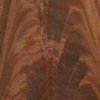
The “curl” figure is found where branches or roots separate from the main trunk; “burr” walnut, with its distinctive speckled grain, is actually cut from a growth or burr on the side of the tree. These decorative sections would only be used in veneer form, but walnut was also used in the solid for chairs etc.
Veneers from this period were laboriously cut by hand, and are typically 1/16th of an inch thick – paper thin veneers are one of the first indications of a Victorian copy, or a reproduction!
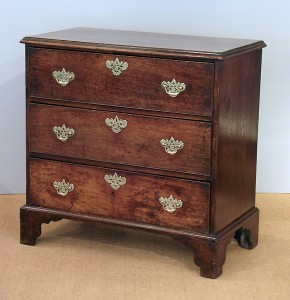
On this lovely chest on stand, dating from about 1740, the drawer fronts have been “quartered” – where four consecutive slices of veneer are laid out to mirror each other. These are framed by “featherbanding”, when two lines of banding are laid in a herringbone pattern. Oak or, as in this case, pine was the timber of choice for carcasses, as its strong tight grain provided a perfectly stable ground to support the fine veneers.
This lovely, faded “honey” colour is typical of an early period walnut piece.


lity mahogany side table, dating from about 1840, is stamped ‘Gillows’. Gillows of Lancaster was established by Robert Gillow in 1728 and continued by his two sons. They were a unique firm: no other cabinet makers were in business for so long a period, and no other provincial firms had a showroom and workshop in 18th century London; they were responsible for some of the finest pieces of English cabinet work during the late 18th and early 19th century. They had a wide range of clients, from aristocracy to the merchant classes. All designs were practical and of the best materials, and above all was the quality of craftsmanship: two hundred years later drawers still glide in and out smoothly. The attention to detail in this table is wonderful; the reeded legs are crisply turned, and the drawers reveal a typical Gillows touch: instead of the back edge of the drawer bottom being nailed up into the back, canted slots have been made for the screws, to enable the timber to shrink without the drawer bottom splitting. Extending dining tables were a Gillow invention, and inventiveness and ingenuity characterised their work; the Gillow Archives 1728-1931 are the largest and longest cabinetmakers’ records to have survived in the world..jpg)